Mark Ghanimé & Catherine Lemieux Talk Helix
By Jamie Ruby
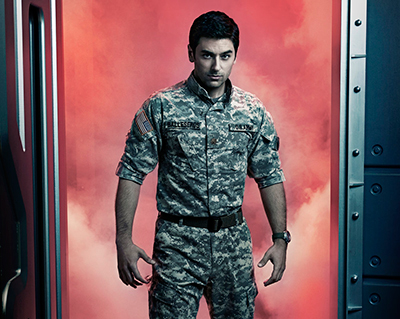
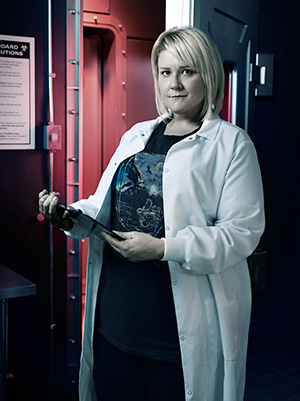
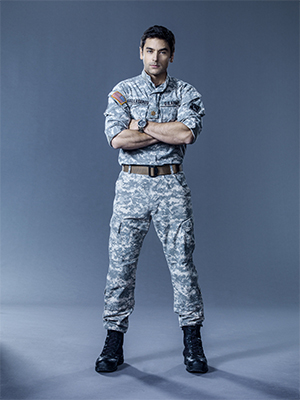
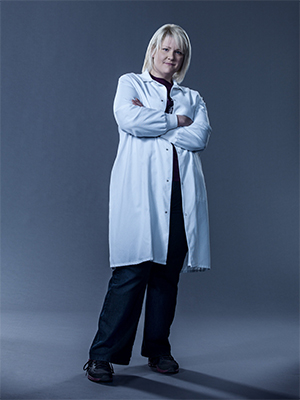
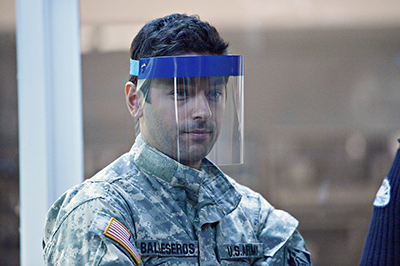
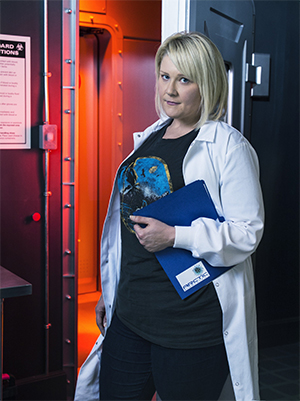
 Friday Syfy's hit Helix returns with an all-new exciting episode. In preparation, Mark Ghanimé, who plays Major Sergio Balleseros, and Catherine Lemieux, who plays veterinary pathologist Dr. Doreen Boyle, recently talked to the digital media about the series.
Lemieux talked to SciFi Vision about her preparation for the role, "I did a lot of computer work. Thank goodness for computers and the Information Age. I'm also very familiar with animals as well. I just - as a veterinarian I've seen a lot of veterinarians with the various pets I've had in my life. So I think some of the research was actually just life experience I think in that sense.
"But I don't know if a lot can prepare you for that kind of line of work of just going into nowhere and dealing with deadly diseases and fear and stuff."
 The actress also added a bit later, "I just wanted to point out that we also had a vet on set. And she was great. She's somebody that I could use a total resource...I considered that such a gift from production to be able to speak to somebody who actually is a veterinarian and who deals with that on a day to day basis. So that was really, really a great help."
Ghanimé also talked to the site about his own preparation, "For myself, it's funny because just last year I finished a role on a project - kind of a passion project that I helped produce as well as act in. It was a soldier role. And my character in that show was sort of a slightly stripped-down version of Sergio Balleseros, so it was kind of neat, because I did a lot of work previous going into that other project, and it sort of helped carry on into this project, so I was a bit more informed due to my previous work.
"And I just enjoy it. I mean, as a kid growing up playing with GI Joes and all that kind of stuff you always wanted to do these kind of roles or play these kind of characters in your play time. And then when I got into acting I thought it would be a blast to do this and play a doctor and play all these kind of different types of roles.
"But for Balleseros in particular, there's a bit of a darkness that I took on a bit more than my previous roles in any other stuff I've done. So as far as the dialogue and the jargon goes from the military, yeah, I did some reading as far as ranking, and how it goes, and how you would pronounce certain words, like USAMRIID, for example, and just all these different things that I had to say. And then as we got into the show, all the technical mumbo jumbo, all the science stuff, it was definitely something that myself and Catherine and everybody else had to really look at."
Balleseros so far in the series has been quite a shady character that we don't know much about, but fans will get more backstory on him soon, according to the actor. "You just have to wait and find out as far as when the episodes get released. But there's definitely going to be some interesting stuff developing with my character. He's got a lot of - he's multifaceted let's just say. So we're going to see some surprises. And we are going to learn as far as his background and where he comes from; we're going to learn some stuff with some twists."
The series has a very rich and detailed set. Ghanimé told SciFi Vision,"My favorite and most hated part of the set was the fridge...It was the indoor freezer that we filmed a lot of the outdoor snow scenes in. And my character spends a lot of the time in the snow. As you saw in the first couple episodes that I'm sending out the signals and when I'm seeing the frozen monkeys.
"I spent a lot of time in this fake snow environment, and I both loved and hated it, because it was a challenge as an actor to work with this stuff flying at your face, and the clothing that we wore, and everything. For me the fridge was definitely my favorite and most hated part of the show.
"...And, you know, we had it whatever difficult as far as doing the acting in front of the stuff, but the crew had to spend all the time, no breaks, they couldn't come in and out like we were allowed to as the actors. They had to stay in the fridge for the duration of [the] 13-hour days. So I feel for them more than I feel for us."
Lemieux agreed with her costar about the fridge and added, "At one point, when we were doing the field monkey scene, somebody had brought us some tea...and we thought oh how sweet to bring us tea in this cold environment. But it was essentially to get our breath to have more smoke so you kind of made a joke like, right, [you] thought we were being nice to you but really we just want more breath from you."
The actors talked about not knowing their character's entire journey at the beginning. Lemieux told the site, "I felt like I knew nothing. I felt like I knew nothing, and I felt like I was honestly just really learning every time I would get a script. And I think the math was that we get the script halfway through the episode as we're shooting it, and we get the next script.
"...We get a chance to talk with Cameron [Porsandeh] and the director previous to filming the pilot... We had a chance to speak [with Steven Maeda] but I don't know if was intentional on their part, but for me and my case, I felt like I was kind of left in some kind of mystery which helped to portray that in actual shooting the show, because I really didn't know what the heck was going on, so that helped me with my acting, I think."
Ghanimé said, "I think, you know, with the show when we were given the roles we were told what our character was like and what the basic idea of the show was, but we weren't given a full season [arc], which was kind of nice actually. It keeps a bit of the mystery. And it kept us all on our toes when we'd get a script every other week. We'd get the new script and we'd get to see what we're doing. And it was just a lot of fun. And, I mean, that's life; an event happens in your life and you learn how to adapt or get around it and you proceed on. It's the way we're filming; it's very much in that way which kept it pretty real and didn't look stale in terms of the dialogue delivery, I think."
The actress added, "It helps you to relate to the audience too, I think, to not know what's coming. You kind of get the impression of what the audience is going to feel as well, as they see the shows."
Even though the tone of the series is dark, it's not like that while working on the set. The actress told SciFi Vision, "Oh wow, we are so lucky. I think we're all so lucky in this casting that everybody just genuinely got to know each other and liked each and respected each other, so lucky. I don't know if that always happens. Personally, this is my first television experience, and I was just so terrorized all the time, just personally in that sense.
"So I really relied on Mark so much to work with really. And, again, just a testament to the casting and the skill of all involved in this project. And, again, I think it's a reflection of the success of it is that it was just really well put together in that sense.
 "...I think, again, humor is just something that all of us can use to help us deal with whatever stress we're dealing with in that sense. And so whether it be our characters or us as actors, but it was always the best way to deal with kind of the heavy stuff that was going on is through humor."
Her costar felt the same. "For as serious as the show is as far as the writing and the content and the dialogue and the serious careers of some we have on board, you know, with Billy [Campbell] and Hiroyuki [Sanada]. Those serious people are serious jokesters too and they like to clown about like I do as well. I'm kind of a goof, you know, sometimes. So it's fun to let our inner child out and express how we really feel as opposed to just what's written.
"You know, we're on set and we're around each other—it's camaraderie; it's friendships; it's support. And, you know, a lot of jokes get thrown around and teasing and fun. So I think that is important to develop, I mean, we're effectively a family for five months straight. You know, we work together every single day, 13 hours a day, 14 hours - for quite a long time. And you have to be able to be more than just colleagues in that sense when you're working so creatively on a television series.
"And that goes for the crew as well and the production side, the producers and everybody involved, they're all very friendly and very caring and very fun, and willing to put in the hours with a smile on their faces."
For SciFi Vision the actors lastly described their characters in a few words. For Ghanimé it was "badass with heart," and for Lemieux it was "no nonsense...with passion."
Syfy Conference Call
Helix
Mark Ghanimé and Catherine Lemieux
January 25, 2014
2:00 pm ET
SCIFI VISION: Can you talk about some of the preparation you did, if there was any research that you did before you got the roles?
MARK GHANIMÉ: Catherine?
CATHERINE LEMIEUX: Yeah, I did a lot of computer work. Thank goodness for computers and the Information Age. I'm also very familiar with animals as well. I just - as a veterinarian, I've seen a lot of veterinarians with the various pets I've had in my life. So I think some of the research was actually just life experience I think in that sense.
But I don't know if a lot can prepare you for that line of work, of just going into nowhere and dealing with deadly diseases and fear and stuff.
MARK GHANIMÉ: For myself, it's funny because just last year I finished a role on a project - kind of a passion project that I helped produce as well as act in. It was a soldier role. And my character in that show was a slightly stripped-down version of Sergio Balleseros, so it was neat, because I did a lot of work previous going into that other project, and it helped carry on into this project, so I was a bit more informed due to my previous work.
And I just enjoy it. I mean, as a kid growing up playing with GI Joes and all that kind of stuff you always wanted to do these kind of roles or play these kind of characters in your play time. And then when I got into acting I thought it would be a blast to do this and play a doctor and play all these kind of different types of roles.
But for Balleseros in particular, there's a bit of a darkness that I took on a bit more than my previous roles in any other stuff I've done. So as far as the dialogue and the jargon goes from the military, yeah, I did some reading as far as ranking, and how it goes, and how you would pronounce certain words, like USAMRIID, for example...
CATHERINE LEMIEUX: Yeah.
MARK GHANIMÉ: ...and just all these different things that I had to say. And then as we got into the show, all the technical mumbo jumbo, all the science stuff, it was definitely something that myself and Catherine and everybody else had to really look at.
CATHERINE LEMIEUX: Hey Jamie, I just wanted to point out that we also had a vet on set. And she was great. She's somebody that I could use a total resource. Her name was (Ev) and I don't know her last name. But I considered that such a gift from production to be able to speak to somebody who actually is a veterinarian and who deals with that on a day-to-day basis. So that was really, really a great help.
SCIFI VISION: I'm sure. And Mark, are we going to learn more back story soon? Because it seems like he at least knows something or has worked with Hatake to some extent. So are we going to be finding out more soon?
MARK GHANIMÉ: Yeah, I really hope you do and you just have to wait and find out as far as when the episodes get released. But there's definitely going to be some interesting stuff developing with my character. He's got a lot of - he's multifaceted, let's just say. So we're going to see some surprises.
And we are going to learn as far as his background and where he comes from; we're going to learn some stuff with some twists.
QUESTION: Cat, your personality and she's a great character and you also had the Battlestar Galactica reference line in there too.
CATHERINE LEMIEUX: Yeah. That was great. That was a great gift, yeah.
QUESTION: So as far as developing her personality, was that all in the script? Or you must have brought something to that.
CATHERINE LEMIEUX: Oh, that's a great question. It's definitely a combination of those two things. I think what came from the script and what most of the writers gave to Doreen was definitely a kind of attitude. And I kind of - the idea of someone having the character to just deal with working with disease and being able to relocate places like the Arctic takes a particular kind of personality trait, I think.
So for me, I tapped into Doreen being a hard lady, a no-nonsense lady, so that's how I reached that.
QUESTION: And, Mark, the funny thing about this guy, I think we're still peeling back the layers of who this guy is. But as far as developing him, are you still working on that process or do you pretty much have an idea of who he is?
MARK GHANIMÉ: Oh, I think that's a never-ending process. It's just like trying to discover who you are and as a person you go through changes your life. And when you're 20 you're a different person than when you are when you're 40. You know, there is that process.
For my character for the series, so far for the season I'm done, we finished filming. But I do have some designs for Season 2 if that happens; if everyone's fortunate and everything aligns and we're working on Season 2 and my character is around, I've got some ideas for him for sure. That's something that I'm really looking forward to working on to develop further. Definitely.
QUESTION: Your executive producer, Steve Maeda, called the Narvik virus “an invisible villain.” He said you can't touch it, you can't taste it, but it's there. And The X-Files did this very effectively in so many episodes.
 Thinking on things, real events of viral disaster in world history, the Black Death in the 14th Century or Chernobyl or even Fukushima Daiichi recently, how effective do you think that using fear and then of course the element of hope with your characters is in connecting you, making you sympathetic to viewers?
CATHERINE LEMIEUX: Wow. Wow. I think that that's reflection of life; life is a balance of those two things in a sense of fear and hope through that and of conquering the fears that we get. So I think that's a true reflection, the show reflects the balance of life that we all try to achieve. And we all have fears and we all have to face them in that sense. So it's a very, very human experience in that. It also being a sci-fi experience and having this disease be completely unknown and completely from out of this world maybe, who knows?
MARK GHANIMÉ: Exactly what Catherine says, and also the fact that if you look at some of the characters as we develop the story in the season, some of the infected - the people that get infected in the base - there is the fear and the hope that these people from the CDC can help them. And it's a very important storyline on the secondary and the guest star characters in the show.
A lot of times you don't see too too much of the fear and the hope on the surface of the hero characters. But we have that support from the guest stars on our show. You really get to see what the true feelings are of these people in the space. And I think, yeah, it is exactly human nature.
QUESTION: Do you think that it will be difficult going forward treating such a real world, serious - even though we're not dealing with say the X-Files black oil-type of virus. But say I was on a beach in South California and the Fukushima and San Onofre issues are - they linger a little bit even though we're told that all the radionuclides are just at trace levels now and they've all dissipated. The little fear is always there.
Do you think that having a real-world issue treated in a fantastic sci-fi manner - how do you do that? How do you put that slant on it and keep some levity but the true gravity of the world?
MARK GHANIMÉ: Well I think, if I may, Catherine first...
CATHERINE LEMIEUX: Of course, Mark.
MARK GHANIMÉ: ...we've echoed this a lot on our previous interviews. The fact that what we're doing in this show is not fantastical, is not supernatural, is not beyond the reach of the real world I think that in itself…lends a built-in fear in that it can happen. You look outside your door and those things can occur. And I think that itself is enough to put the fear of God into people.
CATHERINE LEMIEUX: The possibility, I think, of it - the possibility of any situation that's on television or on film or what have you is definitely the link with the audience in that sense. If an audience member can identify and see themselves in this problem that these characters are having then you really do have a connection.
QUESTION: I have a friend who is the chair of ophthalmology at UC Davis and I sent her the Infinity contact lens ad; I thought she would find that amusing. And we both weren't quite sure how that fit into the show other than Hatake - his silver eye. So I was curious if you had any answer for her on how that relates to the show?
MARK GHANIMÉ: I have a huge answer. It's a juicy one. Are you ready for this?
QUESTION: Yes. Yes.
MARK GHANIMÉ: No comment.
QUESTION: Okay.
MARK GHANIMÉ: We cannot talk about that. And said with all humor, of course.
QUESTION: There is a tiny bit of humor in your odd couple relationship. Was it always meant to be? [Your] personalities are in the midst of all this fear and creepiness and death and black goo. [There is] a little bit of (unintelligible) humor there, particularly Doreen.
MARK GHANIMÉ: I think obviously part of it is due to the writing. And they paired us up - dialogue-wise they paired us up like that. But I had never met Catherine going into this project. But I was met with open arms and she's a lovely woman. And we had a lot of fun together.
And I think our comfortable behavior with each [other] just lent itself to what we put on film afterwards. And it's just a blast for myself. And she's got a wonderful background in theater and I had a blast learning from her.
CATHERINE LEMIEUX: I couldn't have gotten through this project without the complicity that I had with Mark who, again, we didn't know each other before this project. And he's just a really generous scene partner. I'm very new to working in television and so Mark was always just very, very, very helpful with that. And as he said I think we just developed a relationship.
I think Doreen is a bit me and I'm a bit Doreen. And so, yeah, definitely that is a reflection of - I think our actual relationship off screen.
QUESTION: The show is moving at a very fast pace. Does the epidemic at hand expand into more of a conspiracy thriller mode? Or is the cast we see now the cast we'll always see, except those who die of course? Anyone else come in to make it more of an international conspiracy? Where are you going on that part of it?
MARK GHANIMÉ: Well, if you remember in one of the first episodes when we're coming down the elevator with Hatake, he describes how many scientists and doctors work in the lab - in the Arctic Biosystem space, which lends up a lot of different types of people, ethnicities and backgrounds to bring the story to.
And you will see through the guest stars throughout the show that there is a very good variety of people coming and going in any shape and form.
 QUESTION: Does that mean that we won't have seen them but they will have been there, or do they actually come in from the outside?
MARK GHANIMÉ: No, no they are people that already occur in the base; that already live in the base and work in the base. And then there's other stuff, other factors that we can't quite reveal just yet.
QUESTION: What has creeped you out, if anything? Is there anything that you went, “Oh, this is so gross,” or is it total fun, kid-like fun working with goo and black blood and all that?
CATHERINE LEMIEUX: I think that’s how I felt, a kid in a candy store. I think that's a really good expression. I think I was just in a world of wonder because the special effects are created by a team of artists really so the monkey that attacked me was a work of art really.
Mark kept taking pictures of him too. The things that we come across are really fantastical but obviously in a non-threading kind of context. So, yeah, I think that's a really good description. I think, yeah, kid in a candy store.
I think a lot of people were a bit freaked out for me to be working with rats. I think a lot of people have rat fear but - with the live rats. So that first scene in the pilot episode, a lot of people were just afraid for me but I love animals so that was fun.
MARK GHANIMÉ: They're so cute, those little rats, even the hairless ones.
CATHERINE LEMIEUX: Yeah.
MARK GHANIMÉ: I just want to take them home and love them.
CATHERINE LEMIEUX: Yeah, yeah.
MARK GHANIMÉ: You feel like they didn't get enough love growing up.
I agree with Catherine. Catherine and I we were working in tandem with a lot of the same effects and a lot of the same circumstances for the first few episodes so we got to see a lot of the same things. So, yeah, definitely working with these monkeys that they created - the visual effects monkey - special effects - just the process that it takes to create such wonderful pieces of art that look like live beings on the screen is just amazing.
CATHERINE LEMIEUX: Yeah.
MARK GHANIMÉ: And then when you see them in regular light when all the lights are on in the house and you're looking at these products that are built for the show, but then under the proper lighting and when the cameras are rolling it just adds this completely different level of creep.
CATHERINE LEMIEUX: Yeah. It's not as scary from the side of filming and a lot of stuff is green-screened and stuff like that so you have to imagine what's going on. And so the result, once it's all put together, is a lot different from the experience.
SCIFI VISION: You guys have such a great set, do you have a favorite part of the set?
CATHERINE LEMIEUX: Oh wow.
MARK GHANIMÉ: My favorite and most hated part of the set was the fridge. It was the indoor freezer that we filmed a lot of the outdoor snow scenes in. And my character spends a lot of time in the snow. As you saw in the first couple episodes that I'm sending out the signals and when I'm seeing the frozen monkeys.
I spent a lot of time in this fake snow environment, and I both loved and hated it, because it was a challenge as an actor to work with this stuff flying at your face, and the clothing that we wore, and everything. For me the fridge was definitely my favorite and most hated part of the show.
CATHERINE LEMIEUX: Yeah, I concur with Mark, absolutely. That fridge is a special thing to work with.
MARK GHANIMÉ: And, you know, we had it difficult as far as doing the acting in front of the stuff, but the crew had to spend all the time, no breaks, they couldn’t come in and out like we were allowed to as the actors. They had to stay in the fridge for the duration of 13-hour days. So I feel for them more than I feel for us.
CATHERINE LEMIEUX: Yeah, that's a good point. At one point when we were doing the field monkey scene, somebody had brought us some tea...and we thought oh how sweet to bring us tea in this cold environment. But it was essentially to get our breath to have more smoke so you kind of made a joke like, right, we thought we were being nice to you but really we just want more breath from you.
SCIFI VISION: How much were you guys told at the beginning when you started about what was going to happen? I know a lot of the actors had said they were surprised as things came up. How much did you guys know?
CATHERINE LEMIEUX: I’m going to start that one, Mark. I really - I felt like I knew nothing. I felt like I knew nothing, and I felt like I was honestly just really learning every time I would get a script. And I think the math was that we get the script halfway through the episode as we're shooting it, and we get the next script.
So I really was we get a chance to talk with Cameron and the director previous to filming the pilot...
 MARK GHANIMÉ: Steve Maeda and...
CATHERINE LEMIEUX: Steve, yeah, that's right. We had a chance to speak but I don't know if it was intentional on their part, but for me and my case, I felt like I was left in some kind of mystery which helped to portray that in actual shooting the show, because I really didn't know what the heck was going on, so that helped with my acting, I think.
MARK GHANIMÉ: Yeah, I think, you know, with the show when we were given the roles we were told what our character was like and what the basic idea of the show was, but we weren't given a full season [arc], which was kind of nice actually. It keeps a bit of the mystery. And it kept us all on our toes when we'd get a script every other week. We'd get the new script and we'd get to see what we're doing. And it was just a lot of fun. And, I mean, that's life; an event happens in your life and you learn how to adapt or get around it and you proceed on. It's the way we're filming; it's very much in that way which kept it pretty real and didn't look stale in terms of the dialogue delivery, I think.
CATHERINE LEMIEUX: It helps you to relate to the audience too, I think, to not know what's coming. You kind of get the impression of what the audience is going to feel as well, as they see the shows.
QUESTION: You guys touched upon this. And it was cool the way you guys interacted in the beginning. It was almost adversarial, the GI Joe comment, and yet I think after you (pulled) the nitrogen - way to break into that part that was forbidden I think there was a respect between the two of you that started to develop there a little bit.
MARK GHANIMÉ: Well I think - for my character, he's got his own agenda; he's got his own side story and his own motivation for a lot of the things. But I think he, at first when you're just - when you get together with a group of people and you're supposed to work with them, you're thrown into this situation, you don't really know who they are, you're trying to feel them out.
And I think that's, not to speak for Catherine but her smart-ass remarks to my character were just her way of feeling out who he was and whether he could take it and whether he was really built for this kind of thing.
CATHERINE LEMIEUX: Yeah.
MARK GHANIMÉ: And that's how I took her (reusing) of my character. And I started to respect her, she was the one finding out a lot of the information the first couple of episodes whether - how the virus was not airborne and that gave me a bit of relief. As the character I was able to sink into a bit more with a little less fear. And I think it was just a mutual respect that built throughout the episodes.
CATHERINE LEMIEUX: Yeah, respect is earned and not necessarily just given in that sense. And I think that's a character trait of both Balleseros and Doreen.
MARK GHANIMÉ: Not to say that I didn't think she was a brat and maybe a bit of a pain in the ass but I kind of liked her.
QUESTION: And how much room do you guys have to play with your characters? Can you ad lib a little bit? Were some of those lines that you threw out, were they in the script or did you have a chance to play a little bit?
CATHERINE LEMIEUX: Oh wow.
MARK GHANIMÉ: We obviously [are] given the scripts and the dialogue and we need to get the story out, this isn't a Will Farrell movie where a lot of it is ad lib for the humor. There's a certain amount of story that has to be told and things have to be exposed.
But for the most part if we had a problem with the way something felt as it came out of our mouths, if it didn't seem very character-like or seemed a little difficult and a little contrived, or whatever, we could have a conversation with Cameron and Steve Maeda and the writers and they were glad to just on the fly make changes if it needed it.
And sometimes they said, no, we need it this way and that's fine. We've all got our jobs to do and we just work together and collaborate, that's what makes this so fun.
CATHERINE LEMIEUX: Yeah, I was really astounded at how much we were given in terms of being able to communicate with somebody exactly as Mark said, if something didn't feel right or you didn't know the flow of a line, there was always somebody to talk to about that. And an actors (unintelligible) is to respect the written word in a sense. But we were always given - we had a lot of support, so much support, to make it our own.
SCIFI VISION: So I would have assumed originally that the atmosphere on set would not be upbeat. But it sounds like, from what everybody's saying, it is. So can you talk about that atmosphere and how everyone gets along, besides you two?
CATHERINE LEMIEUX: Oh wow, we are so lucky. I think we're all so lucky in this casting that everybody just genuinely got to know each other and liked each and respected each other, so lucky. I don't know if that always happens. Personally, as I said before, this is my first television experience, and I was just so terrorized all the time, just personally in that sense.
So I really relied on Mark so much to work with really. And, again, just a testament to the casting and the skill of all involved in this project. And again, I think it's a reflection of the success of it is that it was just really well put together in that sense.
MARK GHANIMÉ: You know, for as serious as the show is as far as the writing and the content and the dialogue and the serious careers of some we have on board, you know, with Billy and Hiroyuki. Those serious people are serious jokesters too and they like to clown about like I do as well. I'm kind of a goof, you know, sometimes. So it's fun to let our inner child out and express how we really feel as opposed to just what's written.
You know, we're on set and we're around each other—it's camaraderie; it's friendships; it's support. And, you know, a lot of jokes get thrown around and teasing and fun. So I think that is important to develop. I mean, we're effectively a family for five months straight. You know, we work together every single day, 13 hours a day, 14 hours - for quite a long time. And you have to be able to be more than just colleagues in that sense when you're working so creatively on a television series.
And that goes for the crew as well and the production side, the producers and everybody involved, they're all very friendly and very caring and very fun, and willing to put in the hours with a smile on their faces.
CATHERINE LEMIEUX: Yeah, yeah, I think, again, humor is just something that all of us can use to help us deal with whatever stress we're dealing with in that sense. And so whether it be our characters or us as actors, but it was always the best way to deal with the heavy stuff that was going on is through humor.
SCIFI VISION: Can you both describe your character in three words? It seems to always be a hard one.
CATHERINE LEMIEUX: Wow.
MARK GHANIMÉ: Bad ass with heart.
 CATHERINE LEMIEUX: Yeah. No-nonsense. No-nonsense - is that three words?
MARK GHANIMÉ: That's two. No-nonsense lady?
CATHERINE LEMIEUX: No-nonsense. Yeah, no-nonsense.
MARK GHANIMÉ: Nonsense is one word, dear.
CATHERINE LEMIEUX: With compassion.
QUESTION: I assume that this story line is a one-season story line and the CDC goes elsewhere. And I'll be optimistic and say when it comes back for a second season. Is that true? Is this the kind of show that each week you get a script and you check to see if you're still alive?
MARK GHANIMÉ: For fear of spoiling things, I know that I was a little bit, you know, I would check the first page to make sure my name was on the top of every episode to see that I got to go on another day. And it is one of those things. I mean, as we've seen with shows like Game of Thrones where they - they've done some pretty drastic things to their cast in that series. Nowadays it's the WTF era of television where it's just a lot of shock and awe sometimes...
CATHERINE LEMIEUX: Anything can happen, yeah. Anything can happen really.
MARK GHANIMÉ: Yeah.
Friday Syfy's hit Helix returns with an all-new exciting episode. In preparation, Mark Ghanimé, who plays Major Sergio Balleseros, and Catherine Lemieux, who plays veterinary pathologist Dr. Doreen Boyle, recently talked to the digital media about the series.Lemieux talked to SciFi Vision about her preparation for the role, "I did a lot of computer work. Thank goodness for computers and the Information Age. I'm also very familiar with animals as well. I just - as a veterinarian I've seen a lot of veterinarians with the various pets I've had in my life. So I think some of the research was actually just life experience I think in that sense.
"But I don't know if a lot can prepare you for that kind of line of work of just going into nowhere and dealing with deadly diseases and fear and stuff."
The actress also added a bit later, "I just wanted to point out that we also had a vet on set. And she was great. She's somebody that I could use a total resource...I considered that such a gift from production to be able to speak to somebody who actually is a veterinarian and who deals with that on a day to day basis. So that was really, really a great help."Ghanimé also talked to the site about his own preparation, "For myself, it's funny because just last year I finished a role on a project - kind of a passion project that I helped produce as well as act in. It was a soldier role. And my character in that show was sort of a slightly stripped-down version of Sergio Balleseros, so it was kind of neat, because I did a lot of work previous going into that other project, and it sort of helped carry on into this project, so I was a bit more informed due to my previous work.
"And I just enjoy it. I mean, as a kid growing up playing with GI Joes and all that kind of stuff you always wanted to do these kind of roles or play these kind of characters in your play time. And then when I got into acting I thought it would be a blast to do this and play a doctor and play all these kind of different types of roles.
"But for Balleseros in particular, there's a bit of a darkness that I took on a bit more than my previous roles in any other stuff I've done. So as far as the dialogue and the jargon goes from the military, yeah, I did some reading as far as ranking, and how it goes, and how you would pronounce certain words, like USAMRIID, for example, and just all these different things that I had to say. And then as we got into the show, all the technical mumbo jumbo, all the science stuff, it was definitely something that myself and Catherine and everybody else had to really look at."
Balleseros so far in the series has been quite a shady character that we don't know much about, but fans will get more backstory on him soon, according to the actor. "You just have to wait and find out as far as when the episodes get released. But there's definitely going to be some interesting stuff developing with my character. He's got a lot of - he's multifaceted let's just say. So we're going to see some surprises. And we are going to learn as far as his background and where he comes from; we're going to learn some stuff with some twists."
The series has a very rich and detailed set. Ghanimé told SciFi Vision,"My favorite and most hated part of the set was the fridge...It was the indoor freezer that we filmed a lot of the outdoor snow scenes in. And my character spends a lot of the time in the snow. As you saw in the first couple episodes that I'm sending out the signals and when I'm seeing the frozen monkeys.
"I spent a lot of time in this fake snow environment, and I both loved and hated it, because it was a challenge as an actor to work with this stuff flying at your face, and the clothing that we wore, and everything. For me the fridge was definitely my favorite and most hated part of the show.
"...And, you know, we had it whatever difficult as far as doing the acting in front of the stuff, but the crew had to spend all the time, no breaks, they couldn't come in and out like we were allowed to as the actors. They had to stay in the fridge for the duration of [the] 13-hour days. So I feel for them more than I feel for us."
Lemieux agreed with her costar about the fridge and added, "At one point, when we were doing the field monkey scene, somebody had brought us some tea...and we thought oh how sweet to bring us tea in this cold environment. But it was essentially to get our breath to have more smoke so you kind of made a joke like, right, [you] thought we were being nice to you but really we just want more breath from you."
The actors talked about not knowing their character's entire journey at the beginning. Lemieux told the site, "I felt like I knew nothing. I felt like I knew nothing, and I felt like I was honestly just really learning every time I would get a script. And I think the math was that we get the script halfway through the episode as we're shooting it, and we get the next script.
"...We get a chance to talk with Cameron [Porsandeh] and the director previous to filming the pilot... We had a chance to speak [with Steven Maeda] but I don't know if was intentional on their part, but for me and my case, I felt like I was kind of left in some kind of mystery which helped to portray that in actual shooting the show, because I really didn't know what the heck was going on, so that helped me with my acting, I think."
Ghanimé said, "I think, you know, with the show when we were given the roles we were told what our character was like and what the basic idea of the show was, but we weren't given a full season [arc], which was kind of nice actually. It keeps a bit of the mystery. And it kept us all on our toes when we'd get a script every other week. We'd get the new script and we'd get to see what we're doing. And it was just a lot of fun. And, I mean, that's life; an event happens in your life and you learn how to adapt or get around it and you proceed on. It's the way we're filming; it's very much in that way which kept it pretty real and didn't look stale in terms of the dialogue delivery, I think."
The actress added, "It helps you to relate to the audience too, I think, to not know what's coming. You kind of get the impression of what the audience is going to feel as well, as they see the shows."
Even though the tone of the series is dark, it's not like that while working on the set. The actress told SciFi Vision, "Oh wow, we are so lucky. I think we're all so lucky in this casting that everybody just genuinely got to know each other and liked each and respected each other, so lucky. I don't know if that always happens. Personally, this is my first television experience, and I was just so terrorized all the time, just personally in that sense.
"So I really relied on Mark so much to work with really. And, again, just a testament to the casting and the skill of all involved in this project. And, again, I think it's a reflection of the success of it is that it was just really well put together in that sense.
"...I think, again, humor is just something that all of us can use to help us deal with whatever stress we're dealing with in that sense. And so whether it be our characters or us as actors, but it was always the best way to deal with kind of the heavy stuff that was going on is through humor."Her costar felt the same. "For as serious as the show is as far as the writing and the content and the dialogue and the serious careers of some we have on board, you know, with Billy [Campbell] and Hiroyuki [Sanada]. Those serious people are serious jokesters too and they like to clown about like I do as well. I'm kind of a goof, you know, sometimes. So it's fun to let our inner child out and express how we really feel as opposed to just what's written.
"You know, we're on set and we're around each other—it's camaraderie; it's friendships; it's support. And, you know, a lot of jokes get thrown around and teasing and fun. So I think that is important to develop, I mean, we're effectively a family for five months straight. You know, we work together every single day, 13 hours a day, 14 hours - for quite a long time. And you have to be able to be more than just colleagues in that sense when you're working so creatively on a television series.
"And that goes for the crew as well and the production side, the producers and everybody involved, they're all very friendly and very caring and very fun, and willing to put in the hours with a smile on their faces."
For SciFi Vision the actors lastly described their characters in a few words. For Ghanimé it was "badass with heart," and for Lemieux it was "no nonsense...with passion."
Syfy Conference Call
Helix
Mark Ghanimé and Catherine Lemieux
January 25, 2014
2:00 pm ET
SCIFI VISION: Can you talk about some of the preparation you did, if there was any research that you did before you got the roles?
MARK GHANIMÉ: Catherine?
CATHERINE LEMIEUX: Yeah, I did a lot of computer work. Thank goodness for computers and the Information Age. I'm also very familiar with animals as well. I just - as a veterinarian, I've seen a lot of veterinarians with the various pets I've had in my life. So I think some of the research was actually just life experience I think in that sense.
But I don't know if a lot can prepare you for that line of work, of just going into nowhere and dealing with deadly diseases and fear and stuff.
MARK GHANIMÉ: For myself, it's funny because just last year I finished a role on a project - kind of a passion project that I helped produce as well as act in. It was a soldier role. And my character in that show was a slightly stripped-down version of Sergio Balleseros, so it was neat, because I did a lot of work previous going into that other project, and it helped carry on into this project, so I was a bit more informed due to my previous work.
And I just enjoy it. I mean, as a kid growing up playing with GI Joes and all that kind of stuff you always wanted to do these kind of roles or play these kind of characters in your play time. And then when I got into acting I thought it would be a blast to do this and play a doctor and play all these kind of different types of roles.
But for Balleseros in particular, there's a bit of a darkness that I took on a bit more than my previous roles in any other stuff I've done. So as far as the dialogue and the jargon goes from the military, yeah, I did some reading as far as ranking, and how it goes, and how you would pronounce certain words, like USAMRIID, for example...
CATHERINE LEMIEUX: Yeah.
MARK GHANIMÉ: ...and just all these different things that I had to say. And then as we got into the show, all the technical mumbo jumbo, all the science stuff, it was definitely something that myself and Catherine and everybody else had to really look at.
CATHERINE LEMIEUX: Hey Jamie, I just wanted to point out that we also had a vet on set. And she was great. She's somebody that I could use a total resource. Her name was (Ev) and I don't know her last name. But I considered that such a gift from production to be able to speak to somebody who actually is a veterinarian and who deals with that on a day-to-day basis. So that was really, really a great help.
SCIFI VISION: I'm sure. And Mark, are we going to learn more back story soon? Because it seems like he at least knows something or has worked with Hatake to some extent. So are we going to be finding out more soon?
MARK GHANIMÉ: Yeah, I really hope you do and you just have to wait and find out as far as when the episodes get released. But there's definitely going to be some interesting stuff developing with my character. He's got a lot of - he's multifaceted, let's just say. So we're going to see some surprises.
And we are going to learn as far as his background and where he comes from; we're going to learn some stuff with some twists.
QUESTION: Cat, your personality and she's a great character and you also had the Battlestar Galactica reference line in there too.
CATHERINE LEMIEUX: Yeah. That was great. That was a great gift, yeah.
QUESTION: So as far as developing her personality, was that all in the script? Or you must have brought something to that.
CATHERINE LEMIEUX: Oh, that's a great question. It's definitely a combination of those two things. I think what came from the script and what most of the writers gave to Doreen was definitely a kind of attitude. And I kind of - the idea of someone having the character to just deal with working with disease and being able to relocate places like the Arctic takes a particular kind of personality trait, I think.
So for me, I tapped into Doreen being a hard lady, a no-nonsense lady, so that's how I reached that.
QUESTION: And, Mark, the funny thing about this guy, I think we're still peeling back the layers of who this guy is. But as far as developing him, are you still working on that process or do you pretty much have an idea of who he is?
MARK GHANIMÉ: Oh, I think that's a never-ending process. It's just like trying to discover who you are and as a person you go through changes your life. And when you're 20 you're a different person than when you are when you're 40. You know, there is that process.
For my character for the series, so far for the season I'm done, we finished filming. But I do have some designs for Season 2 if that happens; if everyone's fortunate and everything aligns and we're working on Season 2 and my character is around, I've got some ideas for him for sure. That's something that I'm really looking forward to working on to develop further. Definitely.
QUESTION: Your executive producer, Steve Maeda, called the Narvik virus “an invisible villain.” He said you can't touch it, you can't taste it, but it's there. And The X-Files did this very effectively in so many episodes.
Thinking on things, real events of viral disaster in world history, the Black Death in the 14th Century or Chernobyl or even Fukushima Daiichi recently, how effective do you think that using fear and then of course the element of hope with your characters is in connecting you, making you sympathetic to viewers? CATHERINE LEMIEUX: Wow. Wow. I think that that's reflection of life; life is a balance of those two things in a sense of fear and hope through that and of conquering the fears that we get. So I think that's a true reflection, the show reflects the balance of life that we all try to achieve. And we all have fears and we all have to face them in that sense. So it's a very, very human experience in that. It also being a sci-fi experience and having this disease be completely unknown and completely from out of this world maybe, who knows?
MARK GHANIMÉ: Exactly what Catherine says, and also the fact that if you look at some of the characters as we develop the story in the season, some of the infected - the people that get infected in the base - there is the fear and the hope that these people from the CDC can help them. And it's a very important storyline on the secondary and the guest star characters in the show.
A lot of times you don't see too too much of the fear and the hope on the surface of the hero characters. But we have that support from the guest stars on our show. You really get to see what the true feelings are of these people in the space. And I think, yeah, it is exactly human nature.
QUESTION: Do you think that it will be difficult going forward treating such a real world, serious - even though we're not dealing with say the X-Files black oil-type of virus. But say I was on a beach in South California and the Fukushima and San Onofre issues are - they linger a little bit even though we're told that all the radionuclides are just at trace levels now and they've all dissipated. The little fear is always there.
Do you think that having a real-world issue treated in a fantastic sci-fi manner - how do you do that? How do you put that slant on it and keep some levity but the true gravity of the world?
MARK GHANIMÉ: Well I think, if I may, Catherine first...
CATHERINE LEMIEUX: Of course, Mark.
MARK GHANIMÉ: ...we've echoed this a lot on our previous interviews. The fact that what we're doing in this show is not fantastical, is not supernatural, is not beyond the reach of the real world I think that in itself…lends a built-in fear in that it can happen. You look outside your door and those things can occur. And I think that itself is enough to put the fear of God into people.
CATHERINE LEMIEUX: The possibility, I think, of it - the possibility of any situation that's on television or on film or what have you is definitely the link with the audience in that sense. If an audience member can identify and see themselves in this problem that these characters are having then you really do have a connection.
QUESTION: I have a friend who is the chair of ophthalmology at UC Davis and I sent her the Infinity contact lens ad; I thought she would find that amusing. And we both weren't quite sure how that fit into the show other than Hatake - his silver eye. So I was curious if you had any answer for her on how that relates to the show?
MARK GHANIMÉ: I have a huge answer. It's a juicy one. Are you ready for this?
QUESTION: Yes. Yes.
MARK GHANIMÉ: No comment.
QUESTION: Okay.
MARK GHANIMÉ: We cannot talk about that. And said with all humor, of course.
QUESTION: There is a tiny bit of humor in your odd couple relationship. Was it always meant to be? [Your] personalities are in the midst of all this fear and creepiness and death and black goo. [There is] a little bit of (unintelligible) humor there, particularly Doreen.
MARK GHANIMÉ: I think obviously part of it is due to the writing. And they paired us up - dialogue-wise they paired us up like that. But I had never met Catherine going into this project. But I was met with open arms and she's a lovely woman. And we had a lot of fun together.
And I think our comfortable behavior with each [other] just lent itself to what we put on film afterwards. And it's just a blast for myself. And she's got a wonderful background in theater and I had a blast learning from her.
CATHERINE LEMIEUX: I couldn't have gotten through this project without the complicity that I had with Mark who, again, we didn't know each other before this project. And he's just a really generous scene partner. I'm very new to working in television and so Mark was always just very, very, very helpful with that. And as he said I think we just developed a relationship.
I think Doreen is a bit me and I'm a bit Doreen. And so, yeah, definitely that is a reflection of - I think our actual relationship off screen.
QUESTION: The show is moving at a very fast pace. Does the epidemic at hand expand into more of a conspiracy thriller mode? Or is the cast we see now the cast we'll always see, except those who die of course? Anyone else come in to make it more of an international conspiracy? Where are you going on that part of it?
MARK GHANIMÉ: Well, if you remember in one of the first episodes when we're coming down the elevator with Hatake, he describes how many scientists and doctors work in the lab - in the Arctic Biosystem space, which lends up a lot of different types of people, ethnicities and backgrounds to bring the story to.
And you will see through the guest stars throughout the show that there is a very good variety of people coming and going in any shape and form.
QUESTION: Does that mean that we won't have seen them but they will have been there, or do they actually come in from the outside? MARK GHANIMÉ: No, no they are people that already occur in the base; that already live in the base and work in the base. And then there's other stuff, other factors that we can't quite reveal just yet.
QUESTION: What has creeped you out, if anything? Is there anything that you went, “Oh, this is so gross,” or is it total fun, kid-like fun working with goo and black blood and all that?
CATHERINE LEMIEUX: I think that’s how I felt, a kid in a candy store. I think that's a really good expression. I think I was just in a world of wonder because the special effects are created by a team of artists really so the monkey that attacked me was a work of art really.
Mark kept taking pictures of him too. The things that we come across are really fantastical but obviously in a non-threading kind of context. So, yeah, I think that's a really good description. I think, yeah, kid in a candy store.
I think a lot of people were a bit freaked out for me to be working with rats. I think a lot of people have rat fear but - with the live rats. So that first scene in the pilot episode, a lot of people were just afraid for me but I love animals so that was fun.
MARK GHANIMÉ: They're so cute, those little rats, even the hairless ones.
CATHERINE LEMIEUX: Yeah.
MARK GHANIMÉ: I just want to take them home and love them.
CATHERINE LEMIEUX: Yeah, yeah.
MARK GHANIMÉ: You feel like they didn't get enough love growing up.
I agree with Catherine. Catherine and I we were working in tandem with a lot of the same effects and a lot of the same circumstances for the first few episodes so we got to see a lot of the same things. So, yeah, definitely working with these monkeys that they created - the visual effects monkey - special effects - just the process that it takes to create such wonderful pieces of art that look like live beings on the screen is just amazing.
CATHERINE LEMIEUX: Yeah.
MARK GHANIMÉ: And then when you see them in regular light when all the lights are on in the house and you're looking at these products that are built for the show, but then under the proper lighting and when the cameras are rolling it just adds this completely different level of creep.
CATHERINE LEMIEUX: Yeah. It's not as scary from the side of filming and a lot of stuff is green-screened and stuff like that so you have to imagine what's going on. And so the result, once it's all put together, is a lot different from the experience.
SCIFI VISION: You guys have such a great set, do you have a favorite part of the set?
CATHERINE LEMIEUX: Oh wow.
MARK GHANIMÉ: My favorite and most hated part of the set was the fridge. It was the indoor freezer that we filmed a lot of the outdoor snow scenes in. And my character spends a lot of time in the snow. As you saw in the first couple episodes that I'm sending out the signals and when I'm seeing the frozen monkeys.
I spent a lot of time in this fake snow environment, and I both loved and hated it, because it was a challenge as an actor to work with this stuff flying at your face, and the clothing that we wore, and everything. For me the fridge was definitely my favorite and most hated part of the show.
CATHERINE LEMIEUX: Yeah, I concur with Mark, absolutely. That fridge is a special thing to work with.
MARK GHANIMÉ: And, you know, we had it difficult as far as doing the acting in front of the stuff, but the crew had to spend all the time, no breaks, they couldn’t come in and out like we were allowed to as the actors. They had to stay in the fridge for the duration of 13-hour days. So I feel for them more than I feel for us.
CATHERINE LEMIEUX: Yeah, that's a good point. At one point when we were doing the field monkey scene, somebody had brought us some tea...and we thought oh how sweet to bring us tea in this cold environment. But it was essentially to get our breath to have more smoke so you kind of made a joke like, right, we thought we were being nice to you but really we just want more breath from you.
SCIFI VISION: How much were you guys told at the beginning when you started about what was going to happen? I know a lot of the actors had said they were surprised as things came up. How much did you guys know?
CATHERINE LEMIEUX: I’m going to start that one, Mark. I really - I felt like I knew nothing. I felt like I knew nothing, and I felt like I was honestly just really learning every time I would get a script. And I think the math was that we get the script halfway through the episode as we're shooting it, and we get the next script.
So I really was we get a chance to talk with Cameron and the director previous to filming the pilot...
MARK GHANIMÉ: Steve Maeda and... CATHERINE LEMIEUX: Steve, yeah, that's right. We had a chance to speak but I don't know if it was intentional on their part, but for me and my case, I felt like I was left in some kind of mystery which helped to portray that in actual shooting the show, because I really didn't know what the heck was going on, so that helped with my acting, I think.
MARK GHANIMÉ: Yeah, I think, you know, with the show when we were given the roles we were told what our character was like and what the basic idea of the show was, but we weren't given a full season [arc], which was kind of nice actually. It keeps a bit of the mystery. And it kept us all on our toes when we'd get a script every other week. We'd get the new script and we'd get to see what we're doing. And it was just a lot of fun. And, I mean, that's life; an event happens in your life and you learn how to adapt or get around it and you proceed on. It's the way we're filming; it's very much in that way which kept it pretty real and didn't look stale in terms of the dialogue delivery, I think.
CATHERINE LEMIEUX: It helps you to relate to the audience too, I think, to not know what's coming. You kind of get the impression of what the audience is going to feel as well, as they see the shows.
QUESTION: You guys touched upon this. And it was cool the way you guys interacted in the beginning. It was almost adversarial, the GI Joe comment, and yet I think after you (pulled) the nitrogen - way to break into that part that was forbidden I think there was a respect between the two of you that started to develop there a little bit.
MARK GHANIMÉ: Well I think - for my character, he's got his own agenda; he's got his own side story and his own motivation for a lot of the things. But I think he, at first when you're just - when you get together with a group of people and you're supposed to work with them, you're thrown into this situation, you don't really know who they are, you're trying to feel them out.
And I think that's, not to speak for Catherine but her smart-ass remarks to my character were just her way of feeling out who he was and whether he could take it and whether he was really built for this kind of thing.
CATHERINE LEMIEUX: Yeah.
MARK GHANIMÉ: And that's how I took her (reusing) of my character. And I started to respect her, she was the one finding out a lot of the information the first couple of episodes whether - how the virus was not airborne and that gave me a bit of relief. As the character I was able to sink into a bit more with a little less fear. And I think it was just a mutual respect that built throughout the episodes.
CATHERINE LEMIEUX: Yeah, respect is earned and not necessarily just given in that sense. And I think that's a character trait of both Balleseros and Doreen.
MARK GHANIMÉ: Not to say that I didn't think she was a brat and maybe a bit of a pain in the ass but I kind of liked her.
QUESTION: And how much room do you guys have to play with your characters? Can you ad lib a little bit? Were some of those lines that you threw out, were they in the script or did you have a chance to play a little bit?
CATHERINE LEMIEUX: Oh wow.
MARK GHANIMÉ: We obviously [are] given the scripts and the dialogue and we need to get the story out, this isn't a Will Farrell movie where a lot of it is ad lib for the humor. There's a certain amount of story that has to be told and things have to be exposed.
But for the most part if we had a problem with the way something felt as it came out of our mouths, if it didn't seem very character-like or seemed a little difficult and a little contrived, or whatever, we could have a conversation with Cameron and Steve Maeda and the writers and they were glad to just on the fly make changes if it needed it.
And sometimes they said, no, we need it this way and that's fine. We've all got our jobs to do and we just work together and collaborate, that's what makes this so fun.
CATHERINE LEMIEUX: Yeah, I was really astounded at how much we were given in terms of being able to communicate with somebody exactly as Mark said, if something didn't feel right or you didn't know the flow of a line, there was always somebody to talk to about that. And an actors (unintelligible) is to respect the written word in a sense. But we were always given - we had a lot of support, so much support, to make it our own.
SCIFI VISION: So I would have assumed originally that the atmosphere on set would not be upbeat. But it sounds like, from what everybody's saying, it is. So can you talk about that atmosphere and how everyone gets along, besides you two?
CATHERINE LEMIEUX: Oh wow, we are so lucky. I think we're all so lucky in this casting that everybody just genuinely got to know each other and liked each and respected each other, so lucky. I don't know if that always happens. Personally, as I said before, this is my first television experience, and I was just so terrorized all the time, just personally in that sense.
So I really relied on Mark so much to work with really. And, again, just a testament to the casting and the skill of all involved in this project. And again, I think it's a reflection of the success of it is that it was just really well put together in that sense.
MARK GHANIMÉ: You know, for as serious as the show is as far as the writing and the content and the dialogue and the serious careers of some we have on board, you know, with Billy and Hiroyuki. Those serious people are serious jokesters too and they like to clown about like I do as well. I'm kind of a goof, you know, sometimes. So it's fun to let our inner child out and express how we really feel as opposed to just what's written.
You know, we're on set and we're around each other—it's camaraderie; it's friendships; it's support. And, you know, a lot of jokes get thrown around and teasing and fun. So I think that is important to develop. I mean, we're effectively a family for five months straight. You know, we work together every single day, 13 hours a day, 14 hours - for quite a long time. And you have to be able to be more than just colleagues in that sense when you're working so creatively on a television series.
And that goes for the crew as well and the production side, the producers and everybody involved, they're all very friendly and very caring and very fun, and willing to put in the hours with a smile on their faces.
CATHERINE LEMIEUX: Yeah, yeah, I think, again, humor is just something that all of us can use to help us deal with whatever stress we're dealing with in that sense. And so whether it be our characters or us as actors, but it was always the best way to deal with the heavy stuff that was going on is through humor.
SCIFI VISION: Can you both describe your character in three words? It seems to always be a hard one.
CATHERINE LEMIEUX: Wow.
MARK GHANIMÉ: Bad ass with heart.
CATHERINE LEMIEUX: Yeah. No-nonsense. No-nonsense - is that three words? MARK GHANIMÉ: That's two. No-nonsense lady?
CATHERINE LEMIEUX: No-nonsense. Yeah, no-nonsense.
MARK GHANIMÉ: Nonsense is one word, dear.
CATHERINE LEMIEUX: With compassion.
QUESTION: I assume that this story line is a one-season story line and the CDC goes elsewhere. And I'll be optimistic and say when it comes back for a second season. Is that true? Is this the kind of show that each week you get a script and you check to see if you're still alive?
MARK GHANIMÉ: For fear of spoiling things, I know that I was a little bit, you know, I would check the first page to make sure my name was on the top of every episode to see that I got to go on another day. And it is one of those things. I mean, as we've seen with shows like Game of Thrones where they - they've done some pretty drastic things to their cast in that series. Nowadays it's the WTF era of television where it's just a lot of shock and awe sometimes...
CATHERINE LEMIEUX: Anything can happen, yeah. Anything can happen really.
MARK GHANIMÉ: Yeah.

Latest Articles
Interviews
 I See the Demon: Alexis Zollicoffer, Noah Kershisnik & Dave Martinez on Trust and Deception
Wednesday, 28 October 2026
 Mackenzie Crook & Pearce Quigley on Small Prophets' Origins, Characters & Creatures
Tuesday, 27 October 2026
 Dark Matter: Jimmi Simpson on Ryan's Strengths & Acting Opposite Himself in Season 2
Sunday, 25 October 2026
 Outlander: Blood of My Blood - Sam Retford & Bobby Rainsbury on Dougal's Rescue & Maura's Loyalties
Friday, 23 October 2026
 Outlander: Blood of My Blood Director Emer Conroy on Battle Logistics, Camera Choices and Character Moments
Sunday, 18 October 2026
 Outlander: Blood of My Blood Showrunner Matthew B. Roberts on Introducing Gerard Grey, Book Lore Connections & Telling Women's Stories
Friday, 16 October 2026
 Orion: Drew Van Acker & Debby Ryan on Layered Performances & Shifting Truths
Monday, 12 October 2026
 Guillermo Navarro on Pan’s Labyrinth’s 20-Year Legacy, Oscar Win & the Craft of Cinematography
Sunday, 11 October 2026
 Orion Director Jaco Bouwer on Building Tension and Creating an Otherworldly Atmosphere
Friday, 09 October 2026
 Dark Matter: Amanda Brugel on Blair's Big Reveal, Her Trauma & What's Ahead in Season 2
Wednesday, 07 October 2026
Reviews


